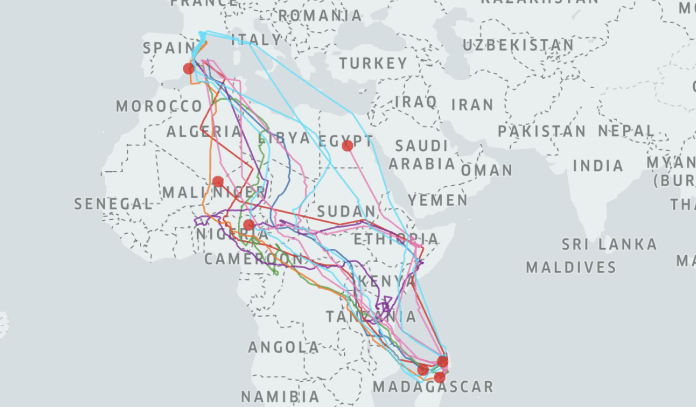
Movements of the Eleonora’s Falcon
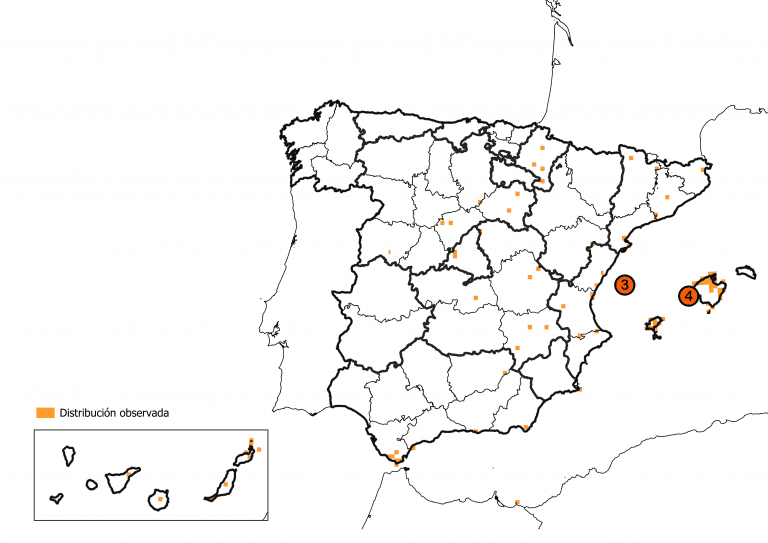
See interactive mapThe breeding population of Eleonora’s falcon in Spain is concentrated on the islands of Majorca and Ibiza, the Columbretes Islands, and islets north of Lanzarote. During this period, birds, especially juveniles, can also be observed in different areas of mainland Spain and islands where the species does not reproduce. It is a strictly summer species in our latitudes, wintering in Madagascar and surrounding islands.
Technical information
Years of tagging
2007 / 2008 / 2009
Download report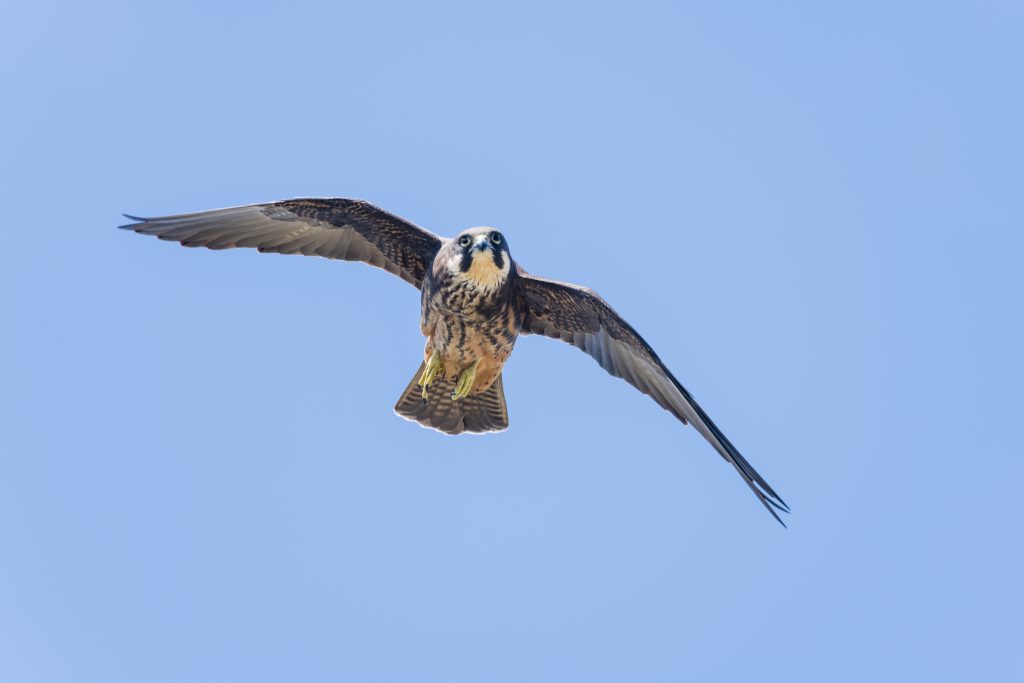
Devices used
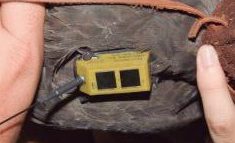
- GPS-GSM datalogger
- GPS-GSM transmitter
- Satellite transmitter
These models work similarly to GPS dataloggers, but with the added benefit of transmitting a message containing five locations daily via GSM. As a result, downloading data with the base station provides a significantly larger amount of daily information on the bird's location if there is mobile phone coverage in the area.
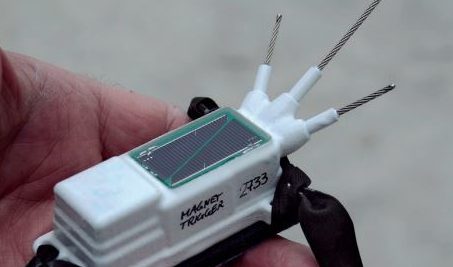
The bird's position is determined using a GPS device, and the location data are transmitted via GSM (global system for mobile communications) to either a server or a mobile terminal for downloading. In areas with limited mobile phone coverage, such as vast regions in Africa, the ability to transmit information is hindered, although data are still collected and sent once a mobile signal is found.
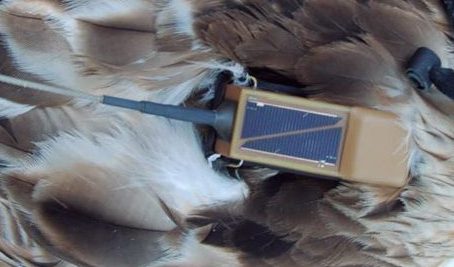
These are devices that record the geographic location and transmit it in the form of a signal that is picked up by the Argos satellite system. The signal is forwarded to a ground reception centre that processes the data, calculates the locations, and makes the information available via the web. There are two types of satellite transmitter: those with a built-in GPS, and those without.
These transmitters can be programmed in various annual cycles to collect and send location data in messages at specific time intervals. The transmitter's battery life decreases as the number of active hours per day, the frequency of location data collection, and the frequency of data transmission increase. These devices are currently available in their conventional version, weighing a minimum of 5 g, or 17 g with GPS.
Specimens by province
More information on other websites about the
Eleonora’s Falcon
European migration atlas
3rd SEO/BirdLife Atlas
Acknowledgements
Funding for this project in the Valencia Region has been provided mainly by Fundación Terra Natura and the Wildlife Service (Valencia Regional Government), led by Miguel Taberner and Juan Jiménez, respectively.
The various activities included in this extensive research project in the Canary Islands have received partial funding from Lanzarote Council, the European Commission, the European Social Fund, and the UvA-BiTS studies.
The work of capturing the specimens in the Balearic Islands counted on: Joan Mayol and Jordi Muntaner from the Balearic Islands Regional Department of the Environment and Territory; Javier de la Puente, Ana Bermejo and Emilio Escudero from SEO-Monticola; José Luis Martínez, Manolo Suárez and Toni Muñoz from Grup Ornitològic Balear. Our work on the Columbretes Islands saw the collaboration of: Vicente Ferrís, E. Sánchez, Blanca Sarzo, M. A. Bartolomé and Clara García. Jesús García took part in sexing the specimens.
Field work in the Canary Islands was carried out with the collaboration of: Manuel de la Riva, Eduardo de la Riva, Juan Luis Barroso, Marc Majem Bofill, Marina Moreno, Pablo Gustems, Wouter Vansteelant, Alberto Pastoriza, Carlos Moreno, Juan Manuel Grande, Enrique Luque, Isabel Luque, Julio Blas, Álvaro Blas, Pilar Batalla, Carlos Chacón, Ignacio Luque, Rumen Martín, Echedey Martín, Zaida Viera, Pilar Vicent, Marcos Mallo, Carmen Díez, Juan Rodríguez and Lanzarote Active Club/Desert Watch. Special thanks to the Jordán and Blancas Suárez families, who, since 2006, have allowed us to access the islets of Alegranza and Montaña Clara, which they own, in order to conduct field campaigns and monitor the population of Eleonora’s falcon.
The Regional Governments of Valencia and the Balearic Islands, through their Departments of the Environment, granted the permits required to tag specimens on the Columbretes Islands and the Balearic Islands, respectively. The Canary Islands Regional Government and Lanzarote Council granted the permits required for the work carried out in the Canary Islands.
All processes involving handling animals were conducted in accordance with the relevant national and regional legislation in each location where the work was carried out, and always adhering to animal welfare standards.
Juan Carlos del Moral of SEO/BirdLife, for all his work coordinating and supporting the Migra programme since its inception, and Carmen Recio, Rafael Landín, Federico de la Hoz and Ramón Castresana of Fundación Iberdrola España, for always defending and believing in this bird monitoring programme from the very outset.
The data collected in this report came from funding awarded within the framework of the following projects or collaborators:
Fundación Terra Natura. Valencia Regional Government’s Wildlife Service. Lanzarote Council. The European Commission through the Marie Sklodowska-Curie Programme (grant number 747729, “”EcoEvoClim””). The European Social Fund for the project “”Adaptation and improvement of the internationalisation of infrastructure of the ICTS-RBD for the ES-FRI-LifeWatch””. The UvA-BiTS studies are facilitated by e-Ecology infrastructure, developed with the support of LifeWatch, and performed on Dutch national e-Infrastructure with the support of SURF Cooperative.
This report is the sixth technical publication in SEO/BirdLife’s Migra programme (www.migraciondeaves.org). This publication was edited and typeset within the framework of this programme, funded principally by Fundación Iberdrola España.