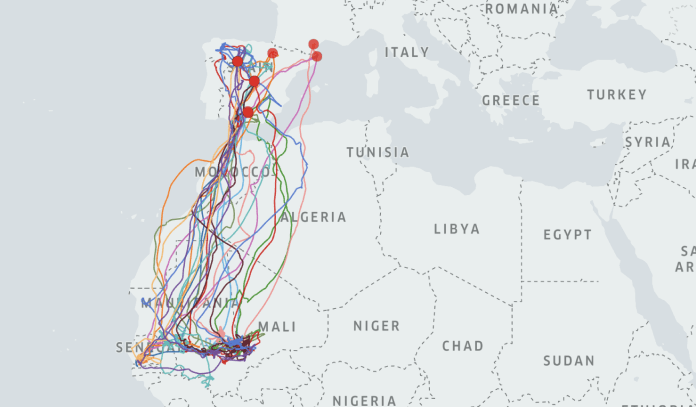
Movements of the Lesser Kestrel
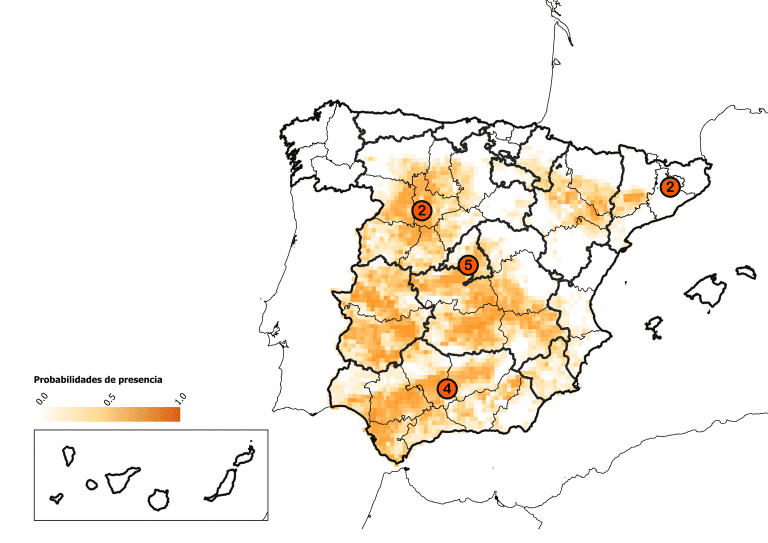
See interactive mapMost of the breeding population of the lesser kestrel is located in the southwestern half of mainland Spain, with other populations in the northeastern quadrant. It is also present in Melilla, but is not found in either of the Spanish island groups or Ceuta. It is essentially a migratory species that disappears almost entirely from mainland Spain in winter.
Technical information
Years of tagging
2013 / 2017
Download report
Devices used
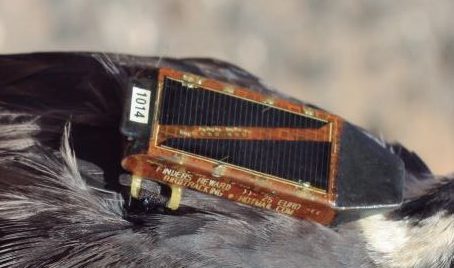
- GPS datalogger
These tags are able to identify locations through their built-in GPS, collecting but not transmitting the information. This means the animal must therefore be recaptured in order to download the information collected. In the latest models, data can be downloaded using a base station positioned at a specific distance from the bird carrying the device, which can range from 200 m to 15 km, depending on the topography. Field work is required to locate the tagged specimen and download the information multiple times a year while it is in its nesting environment.
Specimens by province
More information on other websites about the
Lesser Kestrel
Acknowledgements
SEO/BirdLife expresses its gratitude to the editors and authors of the analysis, results and texts that make up this report, which is key to publicly disseminating the efforts undertaken by various groups and understanding the movements of the lesser kestrel within the breeding population in Spain: Daniel García-Silveira, Javier Bustamante, Jorge García-Macía, Lina Lopez-Ricaurte, Vicente Urios and Wouter Vansteelant.
SEO is also appreciative of the work carried out in bird tagging, data processing, and management of the projects that make up this report, as detailed in the various sections of the credits in this publication.
Naturally, we should also highlight and show our gratitude for the contribution of the collaborating organisations that funded each of the projects developed by Extremadura Regional Government, Doñana Biological Station, Grefa, and SEO/BirdLife itself, which are listed in the relevant section at the start of this report. We are also indebted to Fundación Iberdrola España for its funding since 2011, which has allowed the Migra programme to publish seven additional reports, including works running in parallel to the one presented here for the lesser kestrel, as well as ongoing projects. Also worthy of note is the work carried out by the entire team of the LIFE-ZEPAURBAN project “”Management of urban SPAs in Extremadura”” LIFE 15NAT/ES/001016, and in particular Terra Naturalis, Fotex and Extremadura Regional Government.
From Doñana Biological Station (EBD-CSIC), we would like to thank the organisations that have funded the research projects on the lesser kestrel in recent years, led by Primary Researcher Dr Javier Bustamante: “HORUS Project” (2007-2010, ref: P06-RNM-01712 y 2010-2013 ref: P09- RNM-04588, Andalusia Regional Government), “KESTRELS-MOVE” (2016-2019, ref: CGL2016-79249-P) (AEI/FEDER, UE), “MERCURIO” (2022-2025, ref: PID2020-115793GB) (AEI/FEDER, EU), and “”SUMHAL”” (2021-2023) funded by the Spanish Ministry of Science and Innovation, through the European Regional Development Funds (ERDF) [SUMHAL, LIFEWATCH-2019-09-CSIC-4, POPE 2014-2020]. The editor Lina Lopez-Ricaurte was supported by a grant from the “”La Caixa”” Foundation (ID 100010434, ref. LCF/BQ/DI17/11620014). Funding has also been received from the European Union’s Horizon 2020 research and innovation programme under the Marie Skłodowska-Curie fellowship agreement nº 713673.
From Grefa, we extend a special thanks to the Land Transport Infrastructure Agency (SEITT), the Ministry for Ecological Transition and Demographic Challenge (MITRED), and all the team responsible for the work with lesser kestrels in the organisation: hospital, captive breeding, volunteers and the field work team.
We thank the Regional Governments of Andalusia, Aragón, Castilla y León, Castilla-La Mancha, Catalonia, Valencia, Extremadura and Madrid for providing the necessary permits for the tagging of specimens in their respective regions. The fieldwork, technical support, and data management relied on various collaborations, including: Alba Meijide, Alfredo Ortega, Ana Bermejo, Atanasio Fernández, Beatriz Rodríguez, Carlos Marfil, Curro Ordóñez, David Ramón, Dearbhaile Ni Dhubhail, Diego Jordano, Emma Holroyd, Erin Griffin, Ernesto Aguirre, Ernesto Álvarez, Fernando Garcés-Toledano, Francesc Carbonell, Francisco Javier Pulpillo, Francisco Jesús Martín-Barranco, Javier de la Puente, Jesús Marín, Jesús Sancho, Jose Luis Gonzalez, Jose Mª Abad, Juan Martínez-Dalmau, Lorena Hernández, Manel Pomarol, Manuel Aguilera, Manuel Baena, Manuel Galán, Manuel Vázquez, María Jesús García-Baquero, Miguel Ángel Carrero, Miguel Garcés, Pablo Aycart, Pedro Moreno, Pepa Ruiz, Sergio de la Fuente, Susana Casado, Victor Galvín and Virginia de la Torre.
Finally, this report benefited from the valuable collaboration and support of SEO/BirdLife staff, who guided the publication throughout. In particular, we should mention Juan Carlos del Moral and Jesús Pinilla for their help in editing the text and maps.