
Movements of the Scopoli’s Shearwater
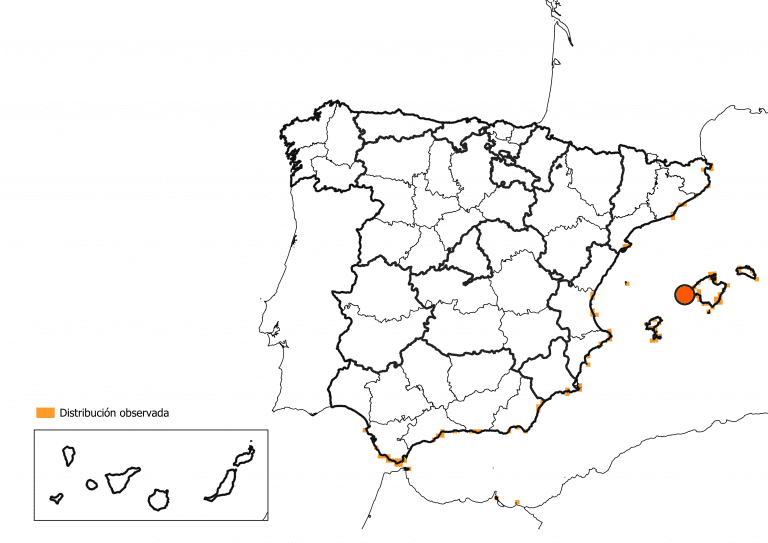
See interactive mapThis taxon is currently considered as two species within Spain: the Atlantic Cory’s shearwater, which breeds in the Canary Islands archipelago, and the Mediterranean Cory’s shearwater, which is endemic to the Mediterranean Sea as a breeder and in Spain nests in the Balearic Islands, Chafarinas Islands and several islets of the eastern Iberian coast and Alboran Sea. It breeds in the ravines and cliffs of these islands. Its populations are only present in Spanish waters and coasts between February and October during the reproductive period. Outside this period, the vast majority of birds migrate south to spend winter in pelagic waters off the coasts of Africa and South America. Their population sizes are largely unknown.
Technical information
Years of tagging
2011
Download report
Devices used
- Geolocator
- GPS-GSM datalogger
- Satellite transmitter
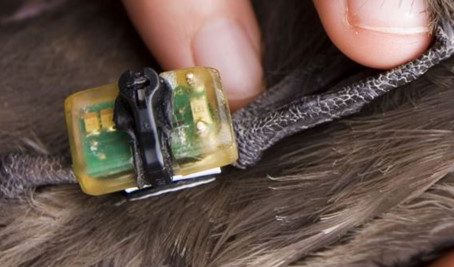
Locations are provided based on geolocation, which estimates the geographic position using sunrise and sunset times and the number of daylight hours per day. They are fitted with a light sensor that measures the variables at regular short intervals, along with an internal clock and a datalogger to record the photoreceptor readings. Latitude is estimated based on the relative length of day and night. Longitude is estimated based on UTC noon and midnight. They have the advantage that there are models of less than one gram, allowing their use in small birds. The animal must be recaptured in order to download the information.
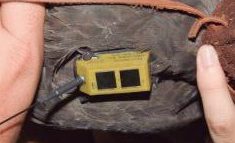
These models work similarly to GPS dataloggers, but with the added benefit of transmitting a message containing five locations daily via GSM. As a result, downloading data with the base station provides a significantly larger amount of daily information on the bird's location if there is mobile phone coverage in the area.
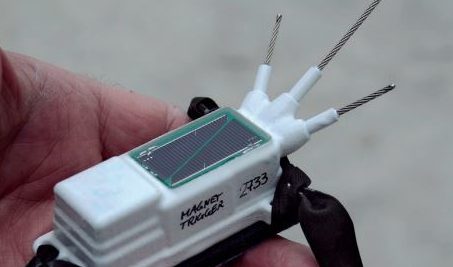
These are devices that record the geographic location and transmit it in the form of a signal that is picked up by the Argos satellite system. The signal is forwarded to a ground reception centre that processes the data, calculates the locations, and makes the information available via the web. There are two types of satellite transmitter: those with a built-in GPS, and those without.
These transmitters can be programmed in various annual cycles to collect and send location data in messages at specific time intervals. The transmitter's battery life decreases as the number of active hours per day, the frequency of location data collection, and the frequency of data transmission increase. These devices are currently available in their conventional version, weighing a minimum of 5 g, or 17 g with GPS.
Specimens by province
More information on other websites about the
Scopoli’s Shearwater
3rd SEO/BirdLife Atlas
Acknowledgements
The authors would like to express their gratitude for the collaboration received from a large number of individuals, as well as the support and approval of multiple administrations. The data presented here could not have been collected without their support. We appreciate all the help offered, and apologise if we have inadvertently omitted to acknowledge any contributions.
Thanks to all the students who collaborated with the seabird research group at the Animal Biology Department (now called the Department of Evolutionary Biology, Ecology and Environmental Sciences), who helped with the complicated field work in the different colonies over these years. Most of them are students from the University of Barcelona, but some also come from other universities: Joan Ferrer, Elisa Miquel, David Torrens, Neus Matamalas, Andrea Soriano, Marta Cruz, Carlos Soria, Marina Codina, Manuel López, Erik Rodríguez, Ignacio de Diego, Laura Zango, Javier Moreno, Ana I. García-Cervigón, Néstor Pérez, Rosana Arizmendi, Antonio Vulcano, Víctor Sanz, Laura M. Stefan, Vero Cortés, Amaia Mendinueta, Iballa de Vicente, Marta Riera, Laila Aranda, Marina Pastor, Herculano Dinis, Chantal Astall, Robert Manzano, Jordi Escoruea, Helena Navalpotro, Patricia Serrano, María Smirly, Alessandro Guici, Carlos Passos, Laura Martínez, Aïda Sabaté, Lluis Coll and Yaiza Parra.
Our special thanks to Juan Bécares and Beneharo Rodríguez (great professionals and friends), who coordinated some of the tagging campaigns in SEO/BirdLife projects that have contributed to this work. Luis Barroso, Santiago Bateman, Javier Blasco, Albert Cama, Raül Escandell, Laura Gangoso, David García, Marcel Gil, Óscar Macián, Rut Martínez, Juan Manuel Martínez-Carmona, Eli Miralles, Walo Moreno, Airam Rodríguez, Blanca Sarzo, José Torrent and Gustavo Tejera also took part in the field work in the SEO/BirdLife campaigns. In Veneguera—one of our most important work colonies—our work began more than a decade ago thanks to the efforts of Joan Navarro and Elena Gómez Díaz. Our work on the Cíes Islands would not have been possible without the involvement of Álvaro Barros and the help of Paula Rodríguez Lapido, Ricardo Álvarez, and the rest of the staff at Atlantic Islands National Park. We would also like to thank Gustavo Tejera and the staff of Timanfaya National Park for helping us with our work in Lanzarote and in this park. On our journey to Alegranza island, we were thankful for the support of Moncho, Melo, and Yeyo, the crew members of the César Manrique, as well as David Duarte and Jeremías, who helped us get to the islet of Montaña Clara. In Cabrera National Park, we received important logistical support from park staff: Joan and Pere, Joan Bover, Eduardo, Jorge, Dani, Angel and Toni Calafell. Miguel McMinn also provided us with valuable information at the start of the work in Cabrera. Thanks also to members of ANSE Association and Rodopechys Group, Jacinto Martínez Ródenas, Ángel Sallent and the different volunteers, who helped out with tagging on the islets around Murcia and Almería. In Columbretes, we were indebted to the support of staff at the Natural Park and the Reserve: Lucía Gimeno, Kike Sánchez, Manuela Viñes, Bruno Sabater, Guillermo Portilla, Juan Torres, Vicente Ferris, Xavi del Señor, Eva Mestre and Patricia González. Joan Navarro, Isabel Afán, Laura Cardador, Manuela Forero and Francisco Ramírez all took part in tagging on the Chafarinas Islands, where they were supported by OAPN staff: Gonzalo Martínez, Javier Díaz, Ángel Sanz, and Javier Zapata. Víctor García Matarranz, from the Ministry of the Environment, also helped out in some of the campaigns that have contributed to this report.
Our intense campaigns in Veneguera would have been significantly more challenging without the assistance of the many different people in Gran Canaria, to whom we are very grateful. A huge thanks to Loli Estevez for always being willing to help us in our work and logistics in Gran Canaria, welcoming us with a smile and helping us in every possible way. We must also thank Pascual Calabuig from Tafira Wildlife Centre for his support on numerous occasions. Staff at Finca Tabaibales Costa Canaria, especially Juan, Alexis and Yerou Lobo, always helped us out and facilitated our work on their estate. In Mogán, Juan and Pepa helped us with accommodation and day-to-day life during the long summer campaigns. Our sincere thanks also to the fishermen of the fishermen’s guilds of Puerto de Mogán (Rubén, and Carmelo and José, from Ascada), Arguineguín (Kiko) and Taliarte (Cuco), in Gran Canaria, for their support and confidence in the guys in charge of the shearwaters, and for their respect for these birds and their love of the sea. Finally, a heartfelt thanks to Manolo Quesada for his closeness, kindness and trust, and for having taught us a lot about those who live underwater alongside the shearwaters, and how to spot birds in the sea from miles away.
The work on Pantaleu islet was possible thanks to the involvement of Daniel Oro and the members of IMEDEA-CSIC Population Ecology Group, for which we are especially grateful to Dani Oro, Albert Fernández, Giacomo Tavecchia, Alejandro Martínez, Ana Sanz, Andreu Rotger, Meritxell Genovart, Pilar Santidrian, Serena Manserra, Noelia Hernández, Ana Payo and Enric Real. We must also thank Martí Mayol, director of Dragonera Nature Park, which Pantaleu islet is part of, for helping us with our work there all this time.
The work included in this report could not have been carried out without the support of staff in the different administrations: Pascual Calabuig, Carlos Canella, Miguel Ángel Peña, Gorgonio Días, Elena Mateo, Trinidad Melgarejo, Luis Pascual, Jeremías Cabrera, Pedro Toledo, Joan Mayol, Joan Terrasa, Martí Mayol, Vicente Piorno, Pepín Fernández Bouzas, Pep Amengual, Juan Jiménez, Emilio Aledo, Juan Carlos Nevado Ariza and Mariano Paracuellos. Similarly, we would like to thank the work carried out by the different ringing organisations, especially Arantza Leal (SEO/BirdLife) and Raül Aymí (ICO).
Yan Tremblay (UMR-MARBEC, France) helped with the modelling of geolocation data, and Simon Benhamou (CEFE/CNRS, France) with analysis of migratory corridors. Special thanks are extended to Frederic Bartumeus and Joan Garriga (CEAB-CSIC) for their invaluable assistance during the initial stages of implementing their behavioural classification algorithm, which ultimately became an integral component of our analysis. Our sincere thanks go to all of them as well.
The photographs of birds tagged with geolocators and GPS recorders that illustrate this book were kindly provided by Maties Rebassa and Javier Elorriaga, having been captured thanks to a good dose of luck. Thanks also to the rest of the authors who have helped enrich this book with their magnificent photographs. Our thanks also to Martí Franch for the illustration that opens this report.
Finally, our thanks to the different administrations that granted the relevant permits: Canary Islands Government and Gran Canaria and Lanzarote Councils; Balearic Islands Government Species Protection Service; the General Directorate of Nature Conservation of the Ministry of the Environment, Territory and Infrastructure of Galicia Regional Government; the Autonomous National Parks Agency; the governing boards of Cabrera, Timanfaya and Atlantic Islands National Parks; Chafarinas National Hunting Refuge; the Ministry of the Environment and Territorial Planning of Andalusia Regional Government; the Ministry of Infrastructure, Territory and Environment of Valencia Regional Government; and the Ministry of Water, Agriculture and Environment of Murcia Region.
We would like to thank Juan Carlos del Moral, of SEO/BirdLife, for all his work coordinating and supporting the Migra programme since its inception, and Carmen Recio, of Fundación Iberdrola España, for always defending and believing in this bird monitoring programme from the very outset.
This report is the third technical publication in SEO/BirdLife’s Migra programme (www.migraciondeaves.org). This publication was edited and typeset within the framework of this programme, funded principally by Fundación Iberdrola España.
The data in this report were collected within the framework of different projects funded by the following organisations:
Universitat de Barcelona projects. Government of Spain, National Programme on Biodiversity, Earth Sciences and Global Change (Biodiversidad): CGL2006-01315/BOS & CGL2006-27909-E/BOS. Government of Spain, Ministry of Science and Innovation, National R&D&I Plan: CGL2009- 11278/BOS. Government of Spain, Ministry of Economy and Competitiveness, State Plan for Scientific and Technical Research and Innovation: CGL2013- 42585-P. Government of Spain, National Parks Agency, Ministry of Agriculture, Food and the Environment: 1248/2014. Fundación Biodiversidad: 18PCA4328. Fundación Biodiversidad and the European Fisheries Fund: 20121964-FEP. Fundación Banco Bilbao Vizcaya Argentaria: BIOCON04/099. Catalonia Regional Government: 2005SGR00744; 2009SGR963; 2014SGR1155. European Commission: CIG9 FP7-PEOPLE-2013- CIG. SEO/BirdLife and Fundación Iberdrola España: Migra Programme.
IMEDEA-CSIC projects. Government of Spain, Ministry of Science and Innovation, National R&D&I Plan: CGL2009- 08298. Government of Spain, Ministry of Economy and Competitiveness, State Plan for Scientific and Technical Research and Innovation: CLG2013- 42203-R.
SEO/BirdLife projects. European Union: LIFE04NAT/ES/000049. European Union: LIFE+ Indemares LIFE07NAT/E/000732. European Union: Interreg FAME. Fundación Iberdrola España: Migra project.
The authors of this work received financial support from the following public programmes and agencies:
José Manuel de los Reyes González: FPU-AP2009-2163 (Min. Education), OAPN-
1248/2014 (Min. Agr., Food and the Env.). Zuzana Zajková: APIF/2012 (University of Barcelona).
Virginia Morera-Pujol: BES-2014-068025 (Min. Econ. and Comp.). Fernanda de Felipe: Doutorado Pleno CSF/Process BEX number – 1307/13-4 (Capes-Brazil). Teresa Militão: SFRH/BD/47467/2008 (FCT-Portugal). Gaia Dell’Ariccia: 2013-BP-B 00226 (Catalonia Regional Government, Prog. Beatriu de Pinós). Raül Ramos: 2010-BPA-00173 (Catalonia Regional Government, Prog. Beatriu de Pinós); JCI-2012-11848 (Min. Econ. and Comp., Prog. Juan de la Cierva).
All processes involving handling animals were conducted in accordance with the relevant national and regional legislation in each location where the work was carried out, and always adhering to animal welfare standards.