Movements of the Audouin’s Gull
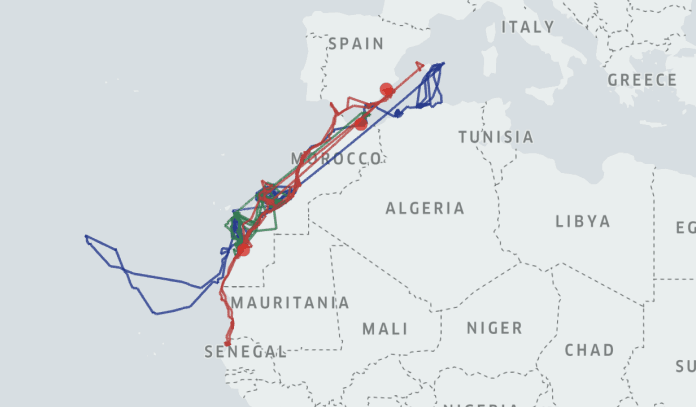
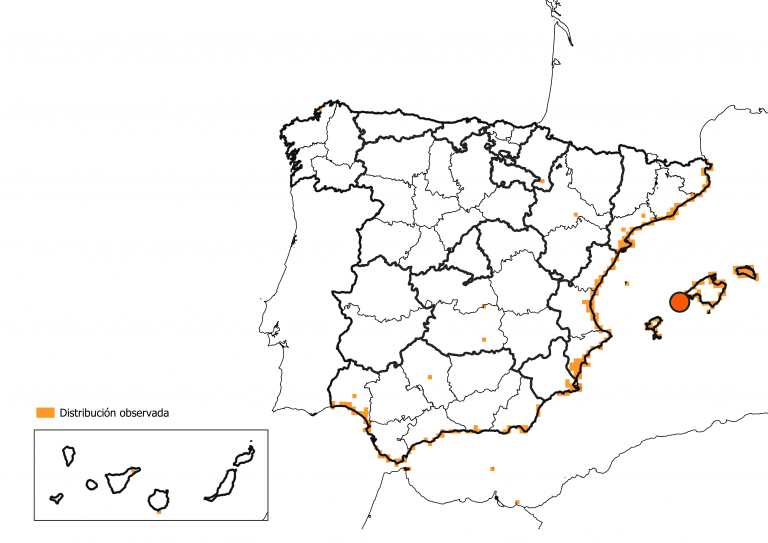
See interactive mapIn Spain it nests only in the Mediterranean area, always in colonies located on the coast or on islands. In North Africa, it nests in Ceuta and Melilla. Island colonies have been established on the Balearic Islands and various islets, including the Columbretes, Alboran, Alhucemas, and Chafarinas. Wintering is scarce on the Spanish coast, as most birds spend winter on the northwest coast of Africa.
Technical information
Years of tagging
2005
Download report
Devices used
- Satellite transmitter
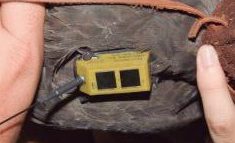
These are devices that record the geographic location and transmit it in the form of a signal that is picked up by the Argos satellite system. The signal is forwarded to a ground reception centre that processes the data, calculates the locations, and makes the information available via the web. There are two types of satellite transmitter: those with a built-in GPS, and those without.
These transmitters can be programmed in various annual cycles to collect and send location data in messages at specific time intervals. The transmitter's battery life decreases as the number of active hours per day, the frequency of location data collection, and the frequency of data transmission increase. These devices are currently available in their conventional version, weighing a minimum of 5 g, or 17 g with GPS.
Specimens by province
More information on other websites about the
Audouin’s Gull
Acknowledgements
First of all, we would like to thank the team at SEO/BirdLife’s Avifauna Study and Monitoring Area (Juan Carlos del Moral, Javier de la Puente and Ana Bermejo) for the trust they have placed in us to carry out this work.
A big thank you to each and every one of the ringers who have ringed Audouin’s Gulls at some point, and to all the volunteers who participated in these ringing campaigns. The significance of these ringings would be rendered insignificant if not for the numerous dedicated observers who have selflessly read, noted and submitted PVC rings readings, as well as those who have found a deceased or injured bird with a metal ring and have reported the information to us. To all of them, too many to list, a huge thank you.
We would also like to thank Doñana Biological Station (EBD-CSIC) for centralising all the information on PVC rings readings in a public database, which has been used in drawing up this report, and specifically Óscar Magaña for sending the data. And also IMEDEA (CSIC-UIB) for management of the codes used. Likewise, we would like to express our gratitude to the bird ringing database of ICONA, under the Ministry of the Environment, currently managed by SEO/BirdLife through its Bird Ringing Office, with special thanks to Arantza Leal for providing data on the recoveries of birds with metal rings from the bird ringers of various endorsing organisations (SEO/BirdLife, ICO, EBD-CSIC and GOB).
Taggings with PTT transmitters and GPS recorders would not have been possible without funding for the LIFE Important Bird Areas (IBA) in Spain (LIFE04NAT/ES/000049) and LIFE+ INDEMARES (LIFE07NAT/E/0732) projects. In this regard, we would like to thank the SEO/BirdLife team in charge of these projects, with special mention to Beneharo Rodríguez, Albert Cama, Asunción Ruiz, Jordi Prieto, Cristina Sánchez and José María Sánchez. Thanks also to the team at the University of Barcelona (UB), led by Carolina Sampera and Lluís Jover, for taking part in the campaigns, to Dani Villero (CTFC) for his help with the models, and to staff at the Mediterranean Institute for Advanced Studies IMEDEA (CSIC-UIB) for providing relevant information for the taggings. We would also like to thank the different administrations for granting the relevant permits, as well as for their support during the field work: the Service for the Protection of Wildlife, Flora and Companion Animals (Department of the Environment and Housing, Catalonia Regional Government) and Delta del Ebro Nature Park; the Species Protection Division of the Balearic Islands Regional Agriculture, Environment and Territory Department; the Nature Reserves of Vedrà, Es Vedranell and the Western Islets; the General Directorate of the Environment of the Region of Murcia; and Andalusia Regional Environment and Territorial Planning Department.
Many different people actively participated in these tagging activities, both through direct field work and by offering support to or within the tagging campaigns: special thanks to Víctor García Matarranz and Manolo García-Tarrasón for their involvement, as well as to Albert Bertolero, Albert Cama, Ángel Sallent, Àngels Ribas, Beneharo Rodríguez, Carles Ibàñez, Carlota Viada, Carolina Sampera, David Bigas, David García, Eli Miralles, Esteban Cardona, Francesc Vidal, Gonzalo G. Barberá, Iolanda Bel, Iván Ramos, Joan Mayol, Joan Torres, Jordi Martí, Jordi Muntaner, Jordi Ruiz, Jorge Calvo, José Manuel Igual, José Torrent, José Vicente Ripoll, Juan Carlos Nevado, Julia Piccardo, Lluís Jover, Maite Louzao, Meritxell Genovart, Miquel Àngel Franch, Oriol Tello, Raül Escandell, Ricard Gutiérrez, Rocío Moreno, Santiago Bateman, Toni Curcó and Virginia Picorelli.
Additional census data in 2007 and 2012 on the Atlantic coasts of Morocco and Western Sahara were kindly provided by Ángel Sallent, Gonzalo G. Barberá and Marcos Ferrández in order to enhance this report. We would also like to thank Marcel Gil-Velasco and Gustavo Tejera for offering us their observations in Dakhla and Lanzarote respectively.
Finally, we thank David Howell and Chas Holt for reviewing the English summary.